Potassium permanganate is not as popular as other chemical compounds, but we probably encounter it more often than we think. Potassium permanganate, also known as permanganate of potash or Condy's crystals, is a chemical compound consisting of two ions: a potassium ion and a permanganate ion.
The physical state of potassium permanganate is an odorless solid, and they look like dark purple or bronze colored crystals. If we dissolve these crystals in water, the solution becomes purple in color. Potassium permanganate is able to oxidize many substances, so it is very well known as a strong oxidizing agent, a substance that accepts or takes electrons from other substances.
Uses Of Potassium Permanganate
Potassium permanganate has various uses in various fields, such as water treatment, organic chemistry, analytical chemistry, and even in survival situations. In this section, we will discuss the various uses of potassium permanganate.
Properties of Potassium permanganate (KMnO4)
1. Potassium permanganate (KMnO4): Action of HeatPotassium permangante on strong heating gives potassium manganate, manganese dioxide and oxygen.
2 KMnO4 ----------> K2MnO4 + MnO2 + O2
2. Oxidising properties of Potassium permanganate (KMnO4)
Potassium permanganate is a powerful oxidizing agent in alkaline or acidic solution. The relevant half reactions are:
1. Alkaline medium (pH > 7)
MnO4- + 2H2O + 3 e- ----------> MnO2 + 4OH-
2. Acidic medium (pH <7)
MnO4- + 8H+ + 5e- ----------> Mn2+ + 4H2O
A few important oxidizing reactions of Potassium permanganate (KMnO4)
1. In acidic medium potassium permanganate oxidizes green ferrous salts to yellow ferric salts
MnO4- + 8H+ + 5Fe2+ ----------> 5Fe3+ + Mn2+ + 4H2O
2. in acidic medium potassium permanganate oxidizes oxalic acid or oxalate salts to CO2and water2 MnO4- + 16H+ + 5 C2O42- -------------> 2 Mn2+ + 10 CO2 + 8 H2O
3. In acidic medium potassium permanganate oxidizes nitrites to nitrate.
2 MnO4- + 6 H+ + 5 NO2- -------------> 2 Mn2+ + 5 NO3- + 3 H2O
4. In acidic medium potassium permanganate oxidises iodides to iodine.
2 MnO4- + 16 H+ + 1 OI- ----------> 2 Mn2+ + 8 H2O + 5 I2
5. In alkaline medium potassium permanganate oxidizes iodides to iodates .
2 MnO4- + H2O + I- ------------> IO3- + 2MnO2 + 2 OH-
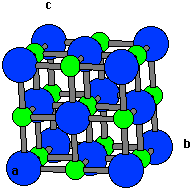
 Shown below are two crystallographic planes in NaCl. Notice that the (111) plane is hexagonally closest packed


